
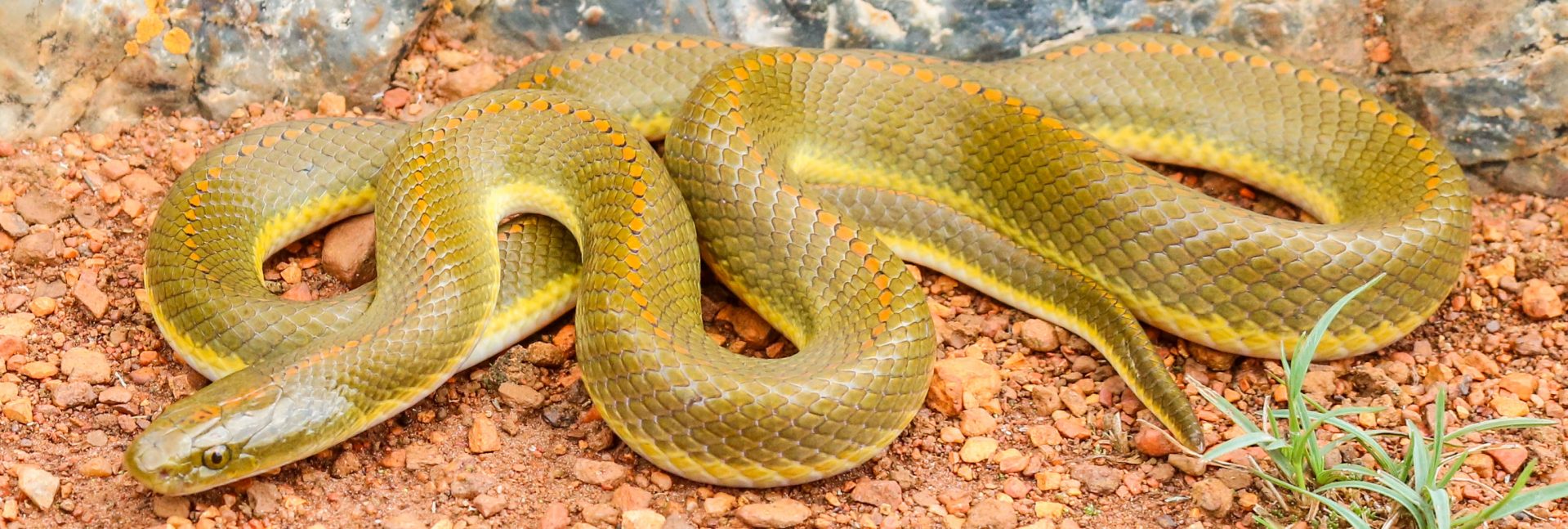
What happens if I get bitten…? By for example a Spotted Skaapsteker or Spotted Grass Snake as they are now more commonly called.
They are known to be fast, nervous snakes and most snake rescuers would have dealt with one of the three species down in Southern Africa. (There are 2 more species)
Being mildly venomous, they are generally free handled during rescues. I for one found that they, being nervous, tend to bite once handled. They would otherwise escape as fast as you can say flash.
For reference, I added a video clip to this post showing a Skaapsteker bite in real life.
In this instance, the bite resulted in a few minutes of itching, stiffness in the knuckle joints and some discomfort with bleeding from the fang puncture wounds and slight welts afterwards.
This was all over in less than 5 minutes.
They are, like some of our other “Mildly Venomous” snake species like the more commonly encountered Sand Snakes (Psammophis), Grass Snakes (Psammophylax), Herald Snakes (Hotamboeia) and Tiger Snakes (Telescopus), considered harmless.
Harmless?
Yes. That means that they do have venom but that their venom has virtually no effect on humans.
Itching, slight to more severe swelling, bleeding from the bite site and minor to severe discomfort with pain, lasting up to two days may be experienced. In very severe cases, medical treatment may be required.
More often than not, snake handlers, having being bitten often, develop a higher level of sensitivity to the venom and will react more severely to a bite. All these snake species are rear fanged and typically some “chewing” is required to deliver more venom and should the snake therefore be allowed to hold on longer, it will do just that, which could also result in more severe reactions.
That said, It is not recommend to go out and allow as many bites from these species as possible. It WILL fast track a build-up of sensitivity to the venom and could result in more severe reactions. Rather AVOID bites.
People do react differently to venom.
Reactions to bee-stings is a good example of this.
A sharp burning sensation, welting and itching around the sting site may be experienced.
For others, a bee sting may result in anything form anaphylaxis through to anaphylactic shock which could be life threatening.
Venom composition and therefore its effects on prey as well as humans are much better understood today than what it was many years ago. Yet, with so many variables involved, a text book reaction with every bite will never be a given.
Two more other aspects I would like to touch on quick is:
- The gape of the snake in the video.
Note around 2, 5 and 25 seconds into the video clip, the “gape” of the snake being close to 170°.
Snakes can open their jaws up to 180°.
The notion that especially back fanged snakes can ONLY bite extremities because they can supposedly not open their jaws wide enough IS a fallacy. They can open their jaws wide enough to bite anywhere required.
Check out this FB post on the jaw mechanics:
https://is.gd/Asj1Gq
- Note the “chewing at 3, 7 and 11 seconds into the clip.
This particular species of snake, like all other rear fanged snakes, have a different type of venom gland, known as duvernoy’s glands which lack compressor muscles around the glands to compress the gland and expel the venom from a large luminal secretory reservoir (venom gland), like most other venomous snakes.
Their glands are comparable to a ‘massed’ serum producing cell structure which involve the release of secretion granules into the lumen. The secretion of the venom from there may be supplemented by mechanical pressure exerted externally.
External pressure is therefore needed to expel the venom via grooved rear fangs. As such, they need to “chew” to expel more venom.
Check out this FB post on fang types:
https://is.gd/dh5zHz
Please note that though most rear fanged snake species in Southern Africa are considered harmless to humans, some of the rear fanged species like the Boomslang (Dispholidus) and the Vine Snake (Thelotornis) have potent venom that are considered potentially deadly even in microscopic quantities.
Therefore a “chew” action compression of the duvernoy’s glands will not necessarily be required to make a bite deadly.
(Thank you Lynn Raw for your input)