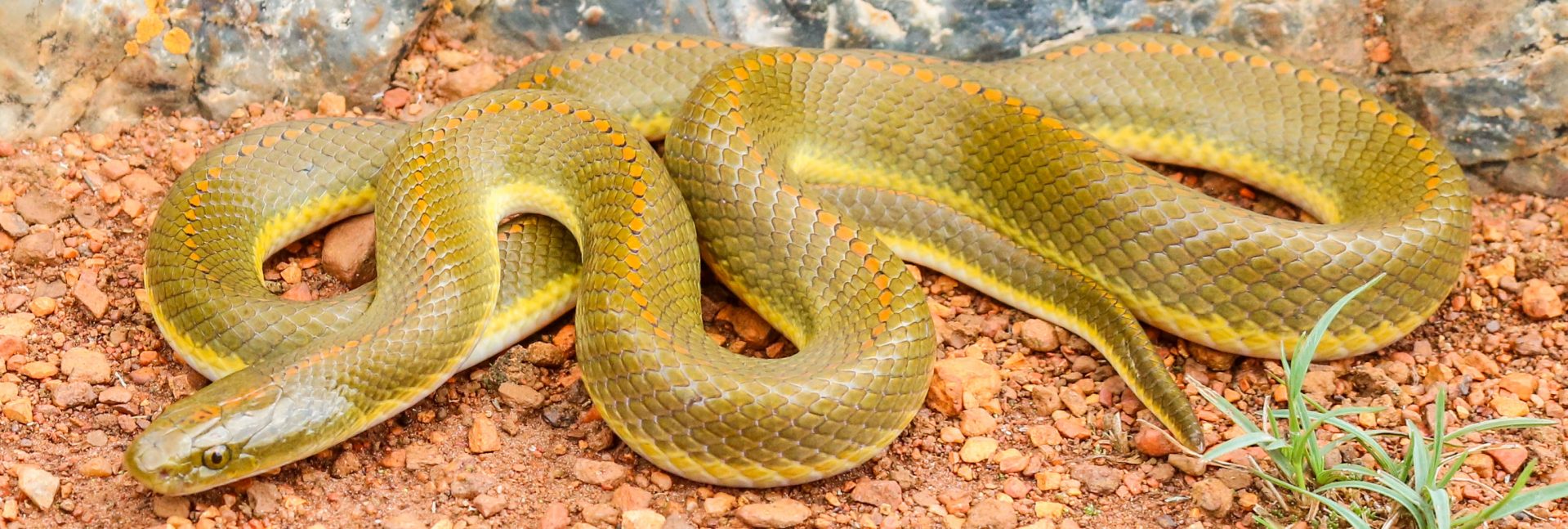
How on earth is that snake going to swallow that huge rat?
Easy, its jaws dislocate. Isn’t it?
I have heard so many explanations from dislocation, disjointing, unhinging and so forth.
It is however not how it works. First we need to get our thinking caps off of mammals with a cranium and an upper jaw fused to it with only the lower jaw moveable to how a snakes’ skull works.
It is actually very interesting. The snake’s skull basically has a cranium too but has separate “jaw” bone combinations connected with elastic ligaments and operated by muscle groups that allow for some very interesting movements.
Lets first focus on the opening or wide enough ‘gaping’; of the jaws.
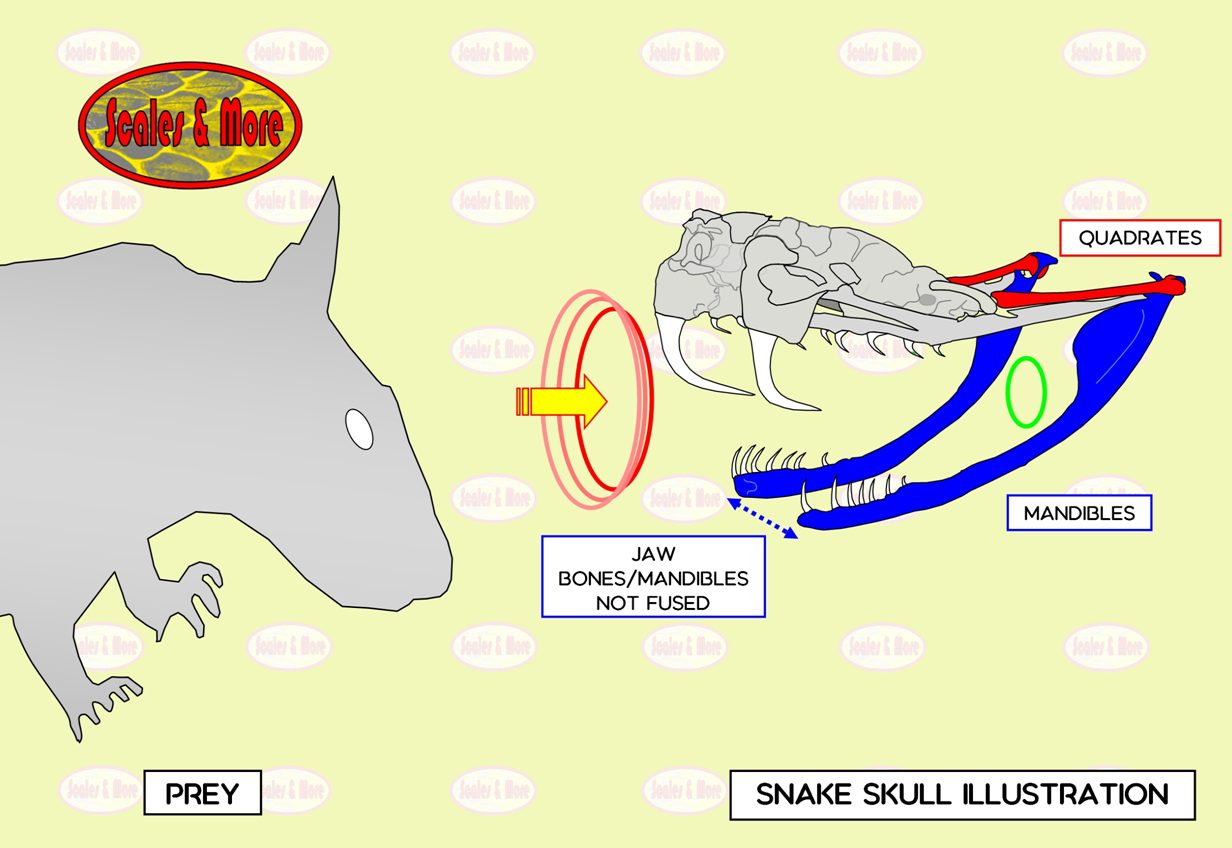
Firstly, the lower jaws or mandibles (From Latin mandibula for jaws) are not fused into one jaw bone like mammals.
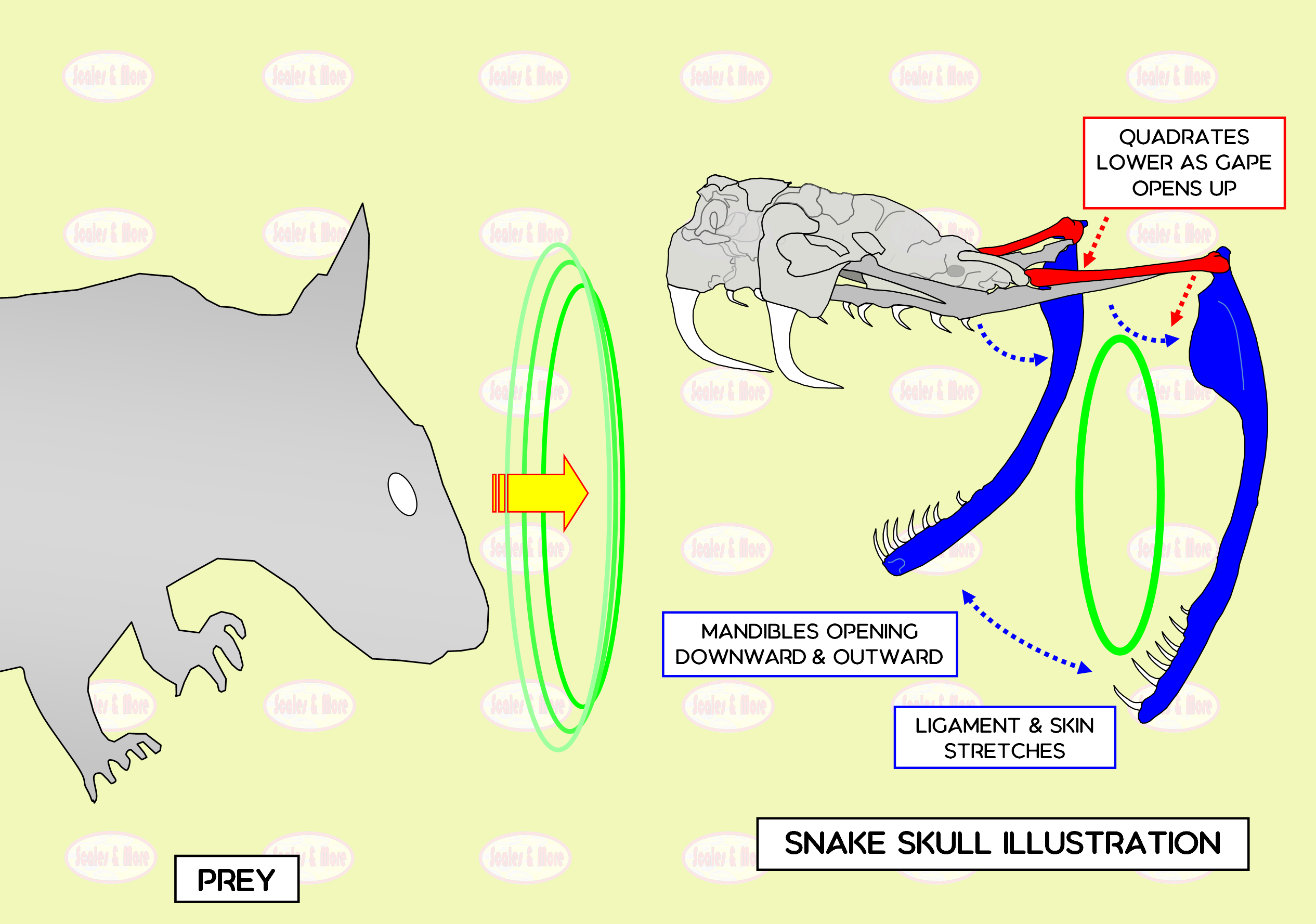
They are connected with a very elastic ligament that stretches together with the skin when opening fairly wide.
The mandibles open downward as can be expected comparative to mammals BUT….
They are attached to bones called the quadrates (from Latin for making square) which opens up downward and back word (lowers) with a slight rotation outward causing the mandibles to open up like arms being swayed open sideways providing for a much wider gape than what one would expect from a mammal.
If this is not enough, a snakes’ skull anatomy allows for more:
The mandibles are a combination of the front part (dentarius to dent from Latin meaning tooth) which in most cases carry the lower teeth and the compound (componere from Latin meaning ‘put togetehr’) bone. From here they connect to the quadrate bones which in turn are connected the supratemporal bones.
We then look at the upper “jaws”, which as stated also functions independently from the cranium and from one another.
They consist of the palatine (relating to the palate) carrying the upper teeth (in snakes with upper teeth) which joined with the Pterygoids (pteryx from Greek meaning “wing”)
These combined with very flexible ligaments and muscles allows for a gape big enough for the snake to swallow prey that would otherwise seem impossible to swallow.
Now for the swallowing process:
The snake cannot “hand” itself the prey item as it doesn’t not have limbs to do so.
Once the prey is incapacitated to the point where the prey can no longer harm the snake, the snake will search for the most suitable side of the prey to start the process of swallowing the prey.
(Usually the head)
Here’s where it gets even better:
Do you remember the various small flat footed wind-up toys?
They used to have the most peculiar way of “walking” – one foot up, then forward then down immediately followed by the opposite foot repeating the motion until the spring has wound down.
Well. With snakes there is no spring but the two sets of “jaws” “walks” the prey in, in a similar fashion.
The upper and lower jaws on the one side “grips” the prey (Adders utilise their large fangs to assist “walking” the prey in from the upper side) and pulls it “in” while the right hand side “releases”.
Once the left is done, the right side duplicates the process while the left hand side releases and in so doing does an alternating grip and release in order to “walk” the prey item into the digestive tract.
(The accompanying two illustrations illustrates where the mandibles and the quadrates are situated in the complete skull.)
#scalesandmore